
Chasing Ice / ICE Chasing Us
A meditation on glaciers melting, toxins being released, and the importance of sight, insight, and vision

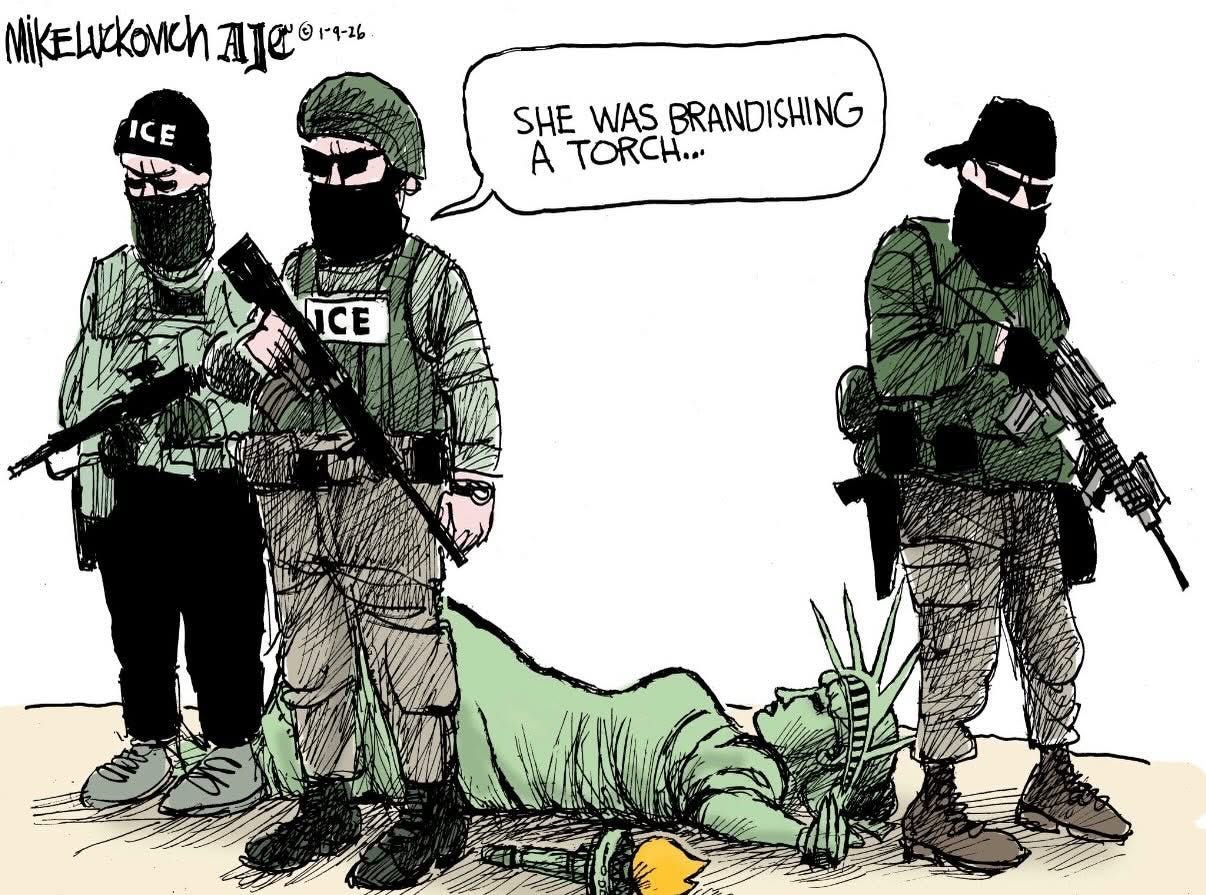
At about 7:30 am Pacific Time on Wednesday, January 7, 2026, a federal ICE Agent, Jonathan Ross, executed Renee Nicole Good, “poet and writer and wife and mom”, mother of three. He shot her in the face, point blank, as she tried to drive away from him, not at him.
I didn’t read about it until that afternoon, well after I gave a Grand Rounds talk on “Cultivating the Narrative of Joy in the Tale of Many Minds.” By then, I was on the treadmill, and I was in tears.
According to leaked video, Ross or one of his colleagues muttered “fucking bitch,” as Good was shot and slumped in the driver seat of her SUV, dead or dying. Slate reports that according to this video, Good was protesting the ICE action. Her wife, Becca, who identifies herself as a disabled veteran, apparently “lightly” mocked Ross as he was filming their license plates, and was attempting to get into the passenger seat as Good tried to drive away.
Due process requires an investigation into this horrific tragedy. Instead, minutes after the killing, DHS Secretary Kristi Noem called Good a “domestic terrorist.” President Trump and others doubled down on the line.
With this crew, every crisis becomes an opportunity to expand their portfolio of chest-thumping, scapegoating, and “conscious gaslighting.”
The story I’ve read about Ross, however, pleads for us to understand him: he’d been recently injured in an ICE stop gone wrong. He’d been dragged by a car driven by an undocumented man wanted for sexually abusing a minor. He. Was. Afraid for his life.
Where have we heard this story? As if the supposed fear of a law enforcement officer justifies deadly force? And yet in this case, it would appear that Good did not pose a threat at all. She does not appear to be taking any measures to harm Ross or the ICE agents.
FDR famously inspired the nation into wartime by saying “the only thing we have to fear is fear itself.” True. But this was the same FDR who illegally imprisoned 120,000+ Japanese Americans out of “wartime hysteria” which became “wartime necessity.” Perhaps one doesn’t sit in a position of power without fear, insecurity, and uncertainty. But it can destroy reason, take down a country or world. We shouldn’t fear people. Our enemy is not people, but qualities of mind.
Good was watching Ross, apparently a lawful citizen observer, and perhaps part of the collective conscience.
The boy in EQUUS blinded a horse because its eyes saw his sexuality.
Shame can provoke violence. Rage at being shamed can provoke violence. Fear can provoke violence. Violence justifies itself all too often, an “impulse gone awry,” as Dr. Bandy Lee has framed it, an impulse that loses the ability to see itself, and shocks and intimidates others as it comes into view. Certainly this is part of its intent: to shock, awe, and intimidate, to master by cruelty what it can’t get by heart, what it’s forgotten in its shambolic yet determined sway.
Perhaps this is a key point: how do we see ourselves? How do we see each other? How do we see others who disagree with us? How do we see our impulses? What do we do when we realize we can’t get our way - that others have their priorities too?
What gaze do we bring when our eyes meet in that moment? Inner, and outer?
Richard Wood wrote in The Much More Dangerous Case of Donald Trump: 50 Psychiatrists and Mental Health Experts Warn Anew that Donald Trump was a victim of “soul murder” by his father, a term described by Shengold and Shaw.
“Shengold and Shaw have referred to as soul murder, a term meant to capture the devastation that the destruction of one person’s subjectivity by another creates. They conceived of soul murder as the most devastating psychic trauma one can endure, as I do.”
The murdered soul turns into a shell of impulses without insight, looking perhaps for conveniences and instant gratifications. Donald Trump seems to seek “wins” for self which he fancies as wins for his faction. He construes his “pursuit of happiness” as dominance and pre-eminence. He’s “leaned his ladder against the wrong wall,” as Joseph Campbell might put it. He is attempting to disrupt the more steady walls, of relationships, social and legal norms, and the Constitution. He “relies on his own mind” to restrain him, but his impulses seem poised to outwit, outplay, and outlast whatever vestige of mind he has. They demand the “certainty” of his survival by the surrender of others.
“Here’s a definition of ignorance: being obsessed and certain about something that you know nothing about.”
— Ravi Chandra, M.D.
“You have to be a killer in life,” Trump was taught. The “law of the jungle,” the “rule of force,” “might makes right.” Roy Cohn taught him to be adversarial in the extreme. Vince MacMahon taught him that in a wrestling ecosystem, you had to play the tough guy, continually roar, thump your chest, and viciously berate your opponents in the “match.” Anyway, it’s all fake, so just put on a show. Trump tosses reality-testing out of the ring as he wrestles with the mind of the world.
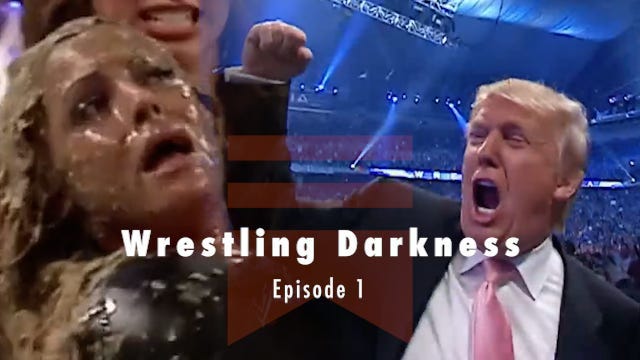
DC was a baseball town before the Trump team came to town. They flipped it onto pro wrestling. Steven Cheung, Trump’s Director of Communications, was the communications director for UFC.
They bring an all-out, total war, zero-sum bias to politics from the wrestling ring.

They aim to murder “good,” and they have. They don’t want to be seen by good, and they have been.
What will our “good” look like? How will we look at them?
I think we have to remember the good in us, and remember that we are not what they are trying to make us into.
On the evening of January 7, I attended press screenings for two short films shortlisted for the Oscars. You can watch them on PBS now.
CLASSROOM 4 documents Reiko Hillyer’s class combining men imprisoned at the Columbia River Correctional Institution with regular undergraduates at Lewis and Clark in Oregon. I was deeply moved by the care Hillyer brings to this difficult work, whose product is the rehumanization of the dehumanized and traumatized, paired with the entwined journey to wholeness of youth “on the other side of the fence.” Caring knows no bounds in this film, and is created communally. To heal, A split society needs boundless eyes and hearts to match, and cannot know its shape before it takes it.
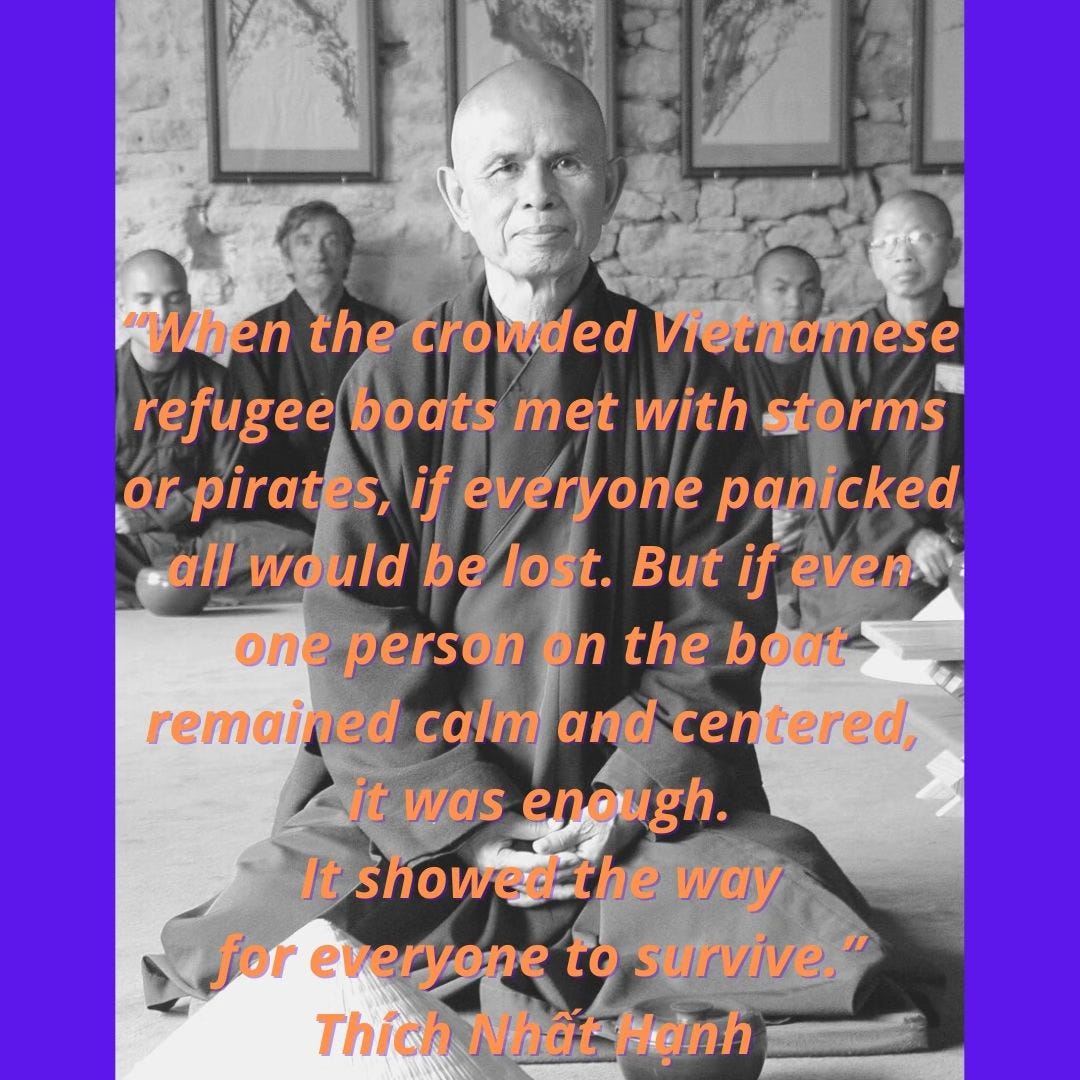
The underlying state of our humanity is confusion, uncertainty, vulnerability, and inadequacy; trauma, loss, grief; and what we do with these. Do we rage? Feel shame? Twist in fear and anguish? Or do we mourn, hold each other, and seek a common joy?
CHASING TIME is a 25 minute sequel to 2012’s award winning feature CHASING ICE, about James Balog’s stunning time lapse photography for the Extreme Ice Survey that documented melting glaciers in Greenland, Iceland, and Alaska. We again see the glaciers’ dramatic, tragic decline, as well as the love of director Jeff Orlowski-Yang for Balog, his life-changing mentor.
Both films reminded me of the extraordinary ways many, many humans care for each other and care for the planet, in some way. The question is not “is it enough?” but “can it happen?” We can turn towards these ways of seeing each other and seeing the world, and away from short-sighted, benighted antagonism. Caring really is the way of the world - though at times it feels like we face long, even infinite, odds, as long and short as the space between us, the space between our minds, warring minds that have an overwhelming fear of intimacy.
In CASTE, Isabel Wilkerson wrote about melting permafrost that released toxic anthrax spores. Buried dangers raged back to harm humans.
Perhaps the melting of ice is connected to ICE chasing us. Connected to a river of salty tears.
Toxins of hatred, greed, and selfishness have always been present, but now they rise, visible, palpable, potent, uncontained, perhaps released by a distressed Earth and deeply uncomfortable humans who can’t name precisely what is under their skin. So they try to wrestle the Earth into submission, instead of inhabiting it. They flee presence into delusions which they try to spin into narrative.
They spin, but the Earth keeps spinning a story too.
I think if we stay grounded, the Earth will spin us too. After all, we don’t have to fear her gravity. She’s trying to hold us close, even if some little men are trying to squirm away, stamp their feet, show her who’s boss.
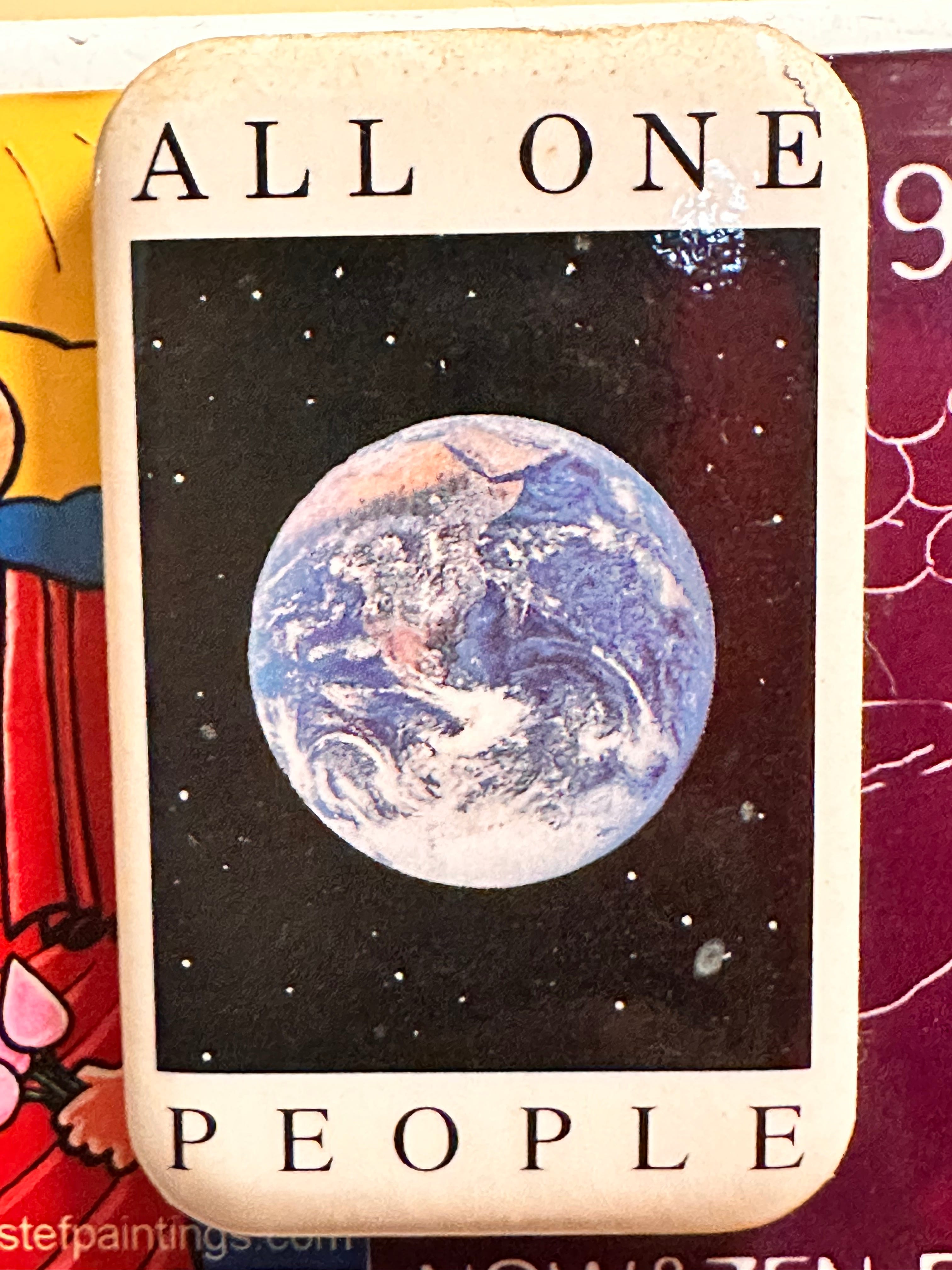
The Earth has tears, and laughter, for us all.
She is a whole self. I think she wants us to be whole, and healed, too.
But we must face the anthrax in us, with heart, mind, body, and soul. With Geocortex.
UPDATE: You can support these groups:
MIRAC - Minnesota Immigrant Rights Action Committee
Twin Cities Coalition for Justice
Racial Justice Network
Families Supporting Families Against Police Violence
(and more ways to support on this Facebook post)
References:
Wertheimer T. Who was Renee Nicole Good, the woman killed by ICE? BBC, January 9, 2026
Cautericci C. ICE killing: In the horrifying new video filmed by Renee Good’s killer, her real “crime” is clear. Slate, January 9, 2026
Ainsley J, Schuppe J, Li DK, Silva D, Gamboa S. New cellphone video shows victim interacting with ICE officer moments before fatal shooting in Minneapolis. NBC News, January 9, 2026
Chandra R. MOSF 20.7: Americans May Disagree on Policy – But Trump is Pathology and Pro Wrestling Gone Way Bad. East Wind ezine, June 27, 2025
Becoming a paid or founding subscriber allows me dedicated writing and research time. You can also now tip me at Ko-Fi.com/sunmoonlight, or donate to my compassion non-profit SF Love Dojo via PayPal. Thanks, though, to all my readers, free and paid! I very much appreciate the Substack Nation we are forming!
Ravi Chandra is a psychiatrist, writer, compassion educator, and civilizational health shaman in San Francisco, and a Distinguished Fellow of the American Psychiatric Association. He is the recipient of the 2025 Kun-Po Soo Award for Achievement in Asian American Psychiatry from the APA and APA Foundation. Here’s his linktree. Please sign up for East Wind and Psychology Today updates via Substack where you can also support his educational and creative mission by becoming a free, paid or founding subscriber. For fourteen years, he was lucky to have his MOSF posts published by the Center for Asian American Media, and is now at work broadening and building a diverse creative community and coalition through reflecting on culture and psychology for East Wind eZine. Sign up for updates here, and see all the posts here. He writes from the metaphorical intersection of The Fillmore and Japantown in San Francisco, where Black and Asian communities have mingled since the end of the incarceration of Japanese Americans during World War II. He literally works there, between two Indian restaurants, go figure. His debut documentary was named Best Film (Festival Director’s Award) at the 2021 Cannes Independent Film Festival. The Bandaged Place: From AIDS to COVID and Racial Justice is available on-demand, and with the discount code “Awake” you can get a 20% discount. His nonfiction debut, Facebuddha: Transcendence in the Age of Social Networks, won the 2017 Nautilus Silver Award for Religion/Spirituality of Eastern Thought. You can find him on Psychology Today, Medium, Twitter, Threads, Facebook, Instagram, YouTube, TikTok, SoundCloud, or better yet, in the IRL.
Thank you. I would suggest substituting "allegedly murdered" for "executed" Ms. Good. BTW, In my self-observation, I've recognized that I'm usually not brought to tears by the horrors or tragedies but by the valiance shown in response to them--like the Minneapolis mayor Jacob Frey's loud and clear message to ICE (and you!). I'm glad you included that movie recommendation--"Classroom 4." It looks like an excellent example of how to respond to damaged people with healing. I connected it to your mentioning "about Ross, however, pleads for us to understand him." I agree with those who've reacted to Ross's history and then his clearly filmed behavior by saying you don't handle your hurt by going out and shooting someone. It would appear that it's done through things like "Classroom 4." One last point--this tragedy is yet another example of profound failure of leadership (through the mentality/behavior of you-know-who that you've outlined). Add it to Vietnam and other misadventures (to put it politely).
A very complex piece, moving rapidly across scales of society, community and person. Thank you for demonstrating how complexity works. We need this!